
You don’t need a gut renovation to make a small cottage bathroom feel charming. In fact, small works in your favor here.
Every detail sits close enough to notice. The beadboard on the wall. The brass tap on the sink. The towel you actually reach for each morning.
The trick is simple. Pick a few classic, warm materials. Keep the colors calm. And sort out storage before you buy anything decorative.
Don’t try to squeeze in a freestanding tub, a double vanity, and a linen tower all at once. In a 5-by-8-foot room, that will feel cramped no matter how pretty each piece is.
Instead, start with what the room already does well. Maybe it’s a window, a high ceiling, an old clawfoot tub, or a sloped eave. Build around that strength, one affordable change at a time.
Start with paint, not plumbing

Paint is the cheapest transformation in a cottage bathroom. It matters even more in a small room, because the walls are always in view.
Go for warm white, not stark white. Look for shades with a creamy undertone, such as Benjamin Moore White Dove, Farrow & Ball Wimborne White, or a similar warm off-white. Use it on the upper walls and the ceiling.
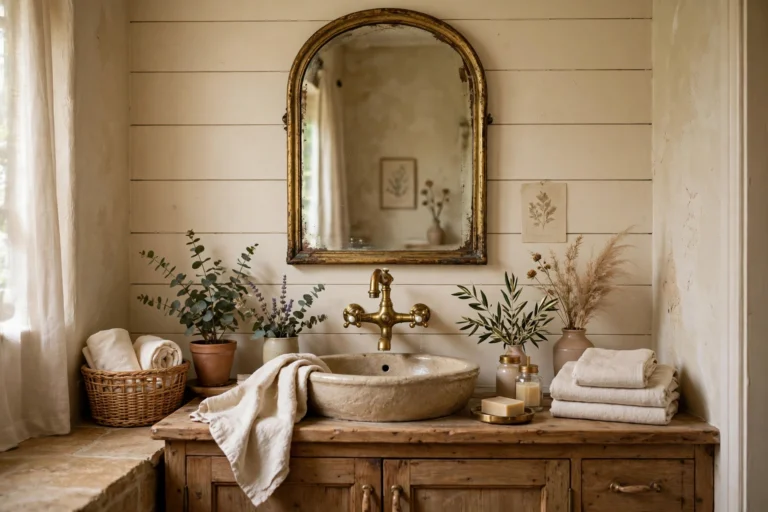
If the room gets little natural light, don’t paint all four walls dark. That will close the space in fast.
Try this instead. Paint the lower third in soft sage, dusty blue, or muted cream. Then add beadboard. You get that cottage texture without a dark, boxed-in feeling.
One gallon of good bathroom paint usually covers a small bathroom. Add primer too if you’re covering a strong color. You’ll likely have some left over for touch-ups.
And don’t forget the finish. Eggshell or satin on the walls wipes clean. Semi-gloss on trim and beadboard stands up to splashes much better.

Beadboard: the fastest cottage signal
Beadboard says “cottage” right away. And it’s far cheaper than tile.
In a small bathroom, run it two-thirds up the wall. Cap it with a simple chair rail. Then paint it the same warm white as your trim. That way, the room reads as one tidy, continuous space.
Near a shower or tub, vinyl beadboard panels are the practical pick. They resist moisture better than raw MDF. You can cut them with a handsaw. Fix them with construction adhesive plus a few finishing nails.
What if your walls are uneven? That’s common in older cottages. Use individual beadboard planks instead of large sheets. Planks follow small bumps better. They also hide gaps at the corners more easily.
Finish the top edge cleanly. This part matters. A ragged cap rail is what makes a DIY beadboard job look unfinished. So take the extra hour. Mitre the corners. Caulk the seam where the rail meets the wall.

Make a small tub or shower feel intentional
Many cottage bathrooms have a tub-shower combo. Trying to disguise it rarely works. So make it a feature instead.
A curved shower rod costs little, but it makes a real difference. It gives you several extra inches of elbow room inside the curtain. It also stops the curtain from clinging to
 you.
Hang the curtain as high as the ceiling allows. Choose a simple linen-look or waffle fabric in white or natural cotton. Skip the busy plastic print.
Got a clawfoot-style tub? Keep the surround simple. Add a freestanding tub filler in brushed brass or oil-rubbed bronze. Place a small wooden stool nearby for towels. Add one plant that tolerates humidity, such as a pothos.
Only have a shower? A teak bath mat, a rainfall-style shower head in a warm metal finish, and a single glass shelf for shampoo will do more than any themed shower curtain.
One caution on glass doors. Don’t add a heavy glass door to a very small shower unless you have at least 30 inches of clear opening. A curtain is lighter, cheaper, and easier to clean.
Storage that looks like decor
Cottage bathrooms fail when toiletries live on every surface. The fix? Closed storage in cottage materials.
Try a wicker basket on top of the toilet tank for spare rolls. Add a small wooden ladder shelf for towels. Swap a flat mirror for a mirrored medicine cabinet.
A ladder shelf leans against the wall. It needs no drilling into tile. It holds rolled towels, a candle, and a small plant without looking like a storage unit.
Over the toilet, one open shelf in reclaimed-look wood works well. But limit it to three things. A basket, a folded towel stack, and a jar. Nothing else.

Under the sink, hang a tension rod inside the cabinet. That gives you a place to hang spray bottles. It frees the floor of the cabinet for baskets.
In the shower, skip the hanging caddy that rusts and swings. Use a corner shelf fixed with silicone adhesive instead. Or try a simple teak shower stool with a shelf underneath. Both keep bottles tidy without drilling through tile.

Floors, mirrors and light on a budget
You don’t need to retile to change a bathroom floor. Peel-and-stick vinyl tiles can sit over a sound existing floor. They cost far less than new tile. And you can remove them later in a rental or before a resale.
Choose a pattern with a small repeat. Checkerboard, herringbone, or small hexagon all work. A small repeat suits the scale of a tiny room. Seal the edges in a wet zone.

For mirrors, think soft shapes. A vintage-style arched or oval mirror softens the boxy feel of a small bathroom. An antique brass frame warms up chrome fixtures without replacing them.
Can’t replace the vanity light? Swap the shades instead. Simple linen or opal glass shades diffuse light. They also hide a dated fixture. Use warm-white bulbs at 2700K. They flatter skin and wood far better than cool daylight bulbs.

If your wiring allows it, add a small dimmer. A cottage bathroom at full brightness at night feels clinical. Dimmed, it feels like a guesthouse.
How to do it in one weekend
How to do it? Start with day one: prep and paint.
Remove the mirror, towel bars, and old caulk. Wash the walls with sugar soap. Fill the holes. Then paint the upper walls and beadboard. Let that dry overnight.
Day two is fitting. Hang the mirror and shelves. Fit the curved shower rod and new curtain. Lay peel-and-stick floor tiles if you’re using them. Swap the light shades and cabinet handles.

Here’s the most common mistake: buying decor first. Don’t. Buy storage first. Then buy one mirror. Then pick towels in two colors only — white plus sage, navy, or terracotta. That stops the room from turning into a patchwork.
Finally, keep one surface completely clear. Usually, that’s the back of the toilet or one side of the vanity. A clear surface is what makes a small room feel calm, not crowded.
What it actually costs
What does it cost? Here’s a realistic budget for a small cottage bathroom refresh, if you do the work yourself:
Paint and primer: $60–$120. Beadboard panels and cap rail: $120–$250. Curved shower rod and linen-look curtain: $50–$90. Mirror: $70–$180. Ladder shelf or over-toilet shelf: $60–$140. Baskets and jars: $40–$80. Light shades and warm bulbs: $40–$90. Peel-and-stick floor tiles: $80–$200. New cabinet handles and a towel ring: $30–$70.

That adds up to roughly $550–$1,220 in total. The exact figure depends on the size of your room and whether you already own tools.
You only need a plumber if you move a toilet, tub, or drain. Changing taps, shower heads, and handles is usually a homeowner job. For water-saving choices, look for WaterSense-labeled bathroom fixtures. Just turn the water off at the stopcock first. And keep the old parts until the new ones are tested.
If your budget is under $300, focus on four things: paint, mirror, shower curtain, and storage. Those four changes alone transform how the room photographs and feels.
What to avoid
What should you avoid? Start with wallpaper. Don’t use dark, heavy wallpaper on all walls in a windowless bathroom. It makes the room feel smaller. It also shows every splash.
Don’t choose a pedestal sink if you have no other storage. You’ll lose the only closed cabinet in the room.
Don’t mix four metal finishes. Pick brass or bronze as your warm accent. Keep chrome or nickel only where it already exists and can’t be changed.

Don’t buy themed accessories in bulk. One botanical print, one wicker basket, and one wooden stool read as cottage. A shelf of roosters, signs, and shells reads as a gift shop.

Finally, don’t try to seal a damp bathroom with paint alone. If you have mould, fix ventilation first. That means a working extractor fan, a window opened after showers, and a quick wipe of grout. Otherwise, the new paint will peel within months.

See more: Bathroom, Ideas by Room, Ideas by Style, 14 Cottage Bathroom Ideas You’ll Love for a Cozy Classic Look, 18 Classic Bathroom Ideas, and Bathroom Remodel Ideas.
FAQ
How can I make a small cottage bathroom look bigger on a budget?
Use warm white on the upper walls, a large mirror, a high-hung shower curtain, and one continuous floor pattern. Keep the palette to three colours and leave one surface clear. Light and repetition do more than knocking down a wall.
Is beadboard good in a bathroom?
Yes, if you choose moisture-resistant panels, paint them with bathroom paint, and caulk the top rail and corners. Avoid raw MDF directly beside a shower, and leave a small gap behind a tub surround so water cannot sit trapped behind the board.
What is the cheapest way to update a cottage bathroom?
Paint, a new mirror, a linen-look shower curtain, warm bulbs and closed basket storage. Together they usually cost $250–$450 and change the room in a weekend, without touching plumbing or tile.